How to Make the Most of 2027 for Camping in the Western Cape
Long weekends have a way of arriving before you're ready. One year you have a free Monday and no plan, and the next year the campsite you wanted is already gone. 2027 gives you time to get ahead. This guide covers the options for camping in the Western Cape, from quick weekends close to home to longer trips further afield, and how to set each one up.
Our 2027 leave planner shows how public holidays can be paired with a few leave days. Use it as a starting point, not a rulebook.
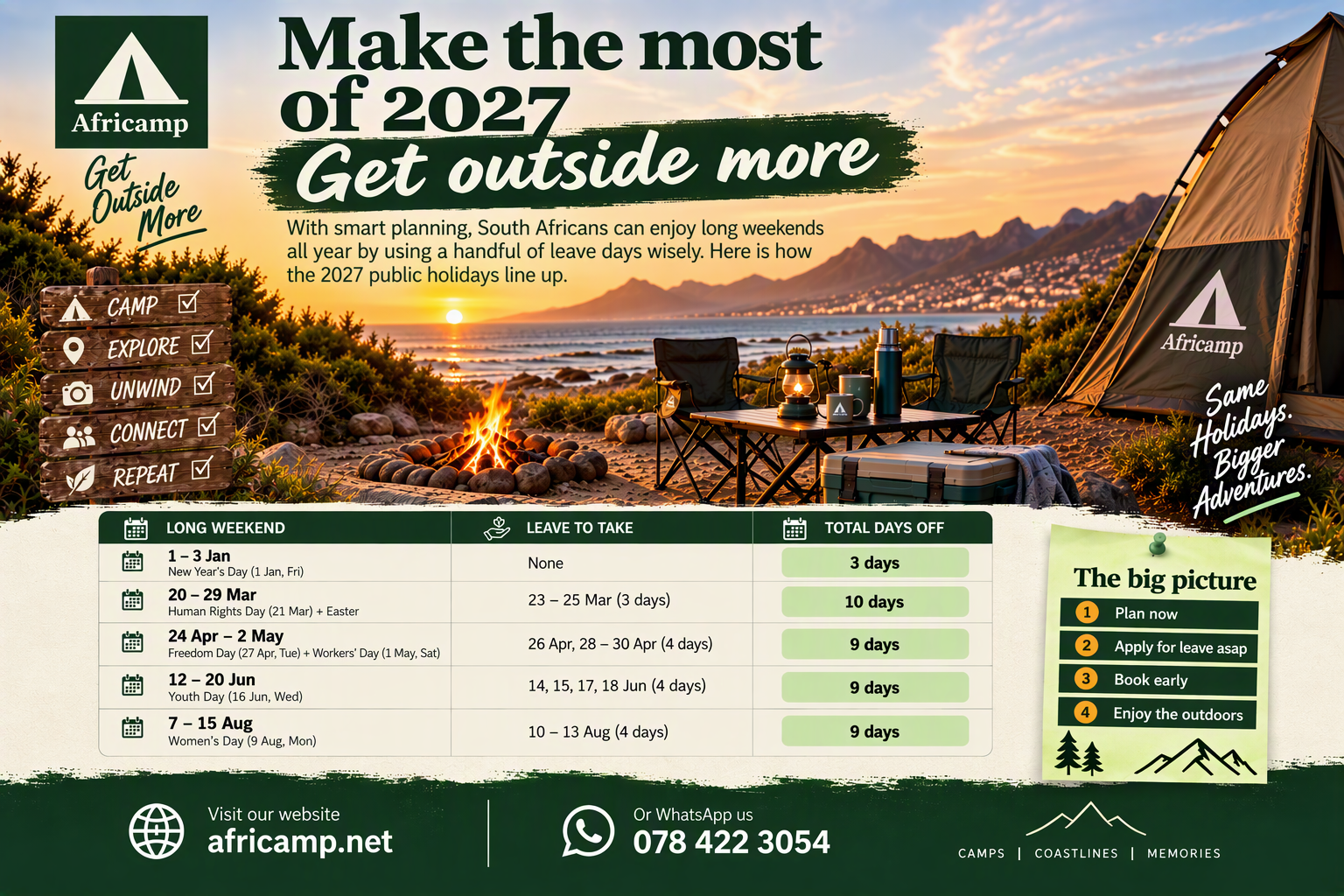
Start with the calendar
Public holidays fall on different days every year, and that decides how much leave a break needs. A holiday that lands on a Friday or Monday gives you a long weekend for free. A holiday in the middle of the week needs one or more leave days to bridge it to the weekend.
- List every South African public holiday for 2027. Use the official government gazette or a trusted calendar.
- Note which ones fall on a weekday and which fall on a weekend. Weekday holidays are where the planning happens.
- Check whether any holiday falls on a weekend without a substitute day. Some do not come with a replacement Monday, so a break built around one may be shorter than it looks.
Why this matters: the calendar sets the shape of your year, and every other decision follows from it.
Map the dates before you dream big.
Choose the kind of break you want
Once you know the calendar, pick the type of break that suits your leave, your budget and your travel time.
- The free long weekend: The holiday already sits next to a weekend, so you need no leave. These suit first-timers and short drives, and they are the easiest to fit in.
- The bridged weekend: One or a few leave days link a holiday to a weekend. This is usually the best value for the leave you spend, and it's the option most campers will use.
- The extended break: Several leave days turn a long weekend into a trip of several nights, often to a reserve further from home.
Match the type to your situation. If you have limited leave, the free and bridged weekends give you the most time outdoors for the fewest days taken. Longer trips need more leave and more planning, so choose one only if you have the days to spare.
Trade-off: the extended break feels like the best reward, but it is also the hardest to get approved and the easiest to cancel. Do not build your whole year around it.
Short breaks still count.
Ask for leave early
Leave is what turns a calendar into a holiday, and it sits with your employer. Annual leave is subject to approval, so the earlier you ask, the better your chances.
- Check your leave balance and carry-over rules first. Ask HR or look at your payroll system. Knowing how many days you have decides which kind of break is realistic.
- Submit requests as early as you can. Early requests are easier for your team to plan around.
- Keep a backup plan. Work out what a shorter trip looks like using only the public holidays. If leave is declined, you still get a weekend away.
Refusals happen, and they are rarely about you. Keep your backup dates in the calendar so one "no" doesn't cancel the whole year.
Ask early, and camp more often.
Book your campsite once your dates are firm
Pick the site after your leave is confirmed. Booking first and then trying to fit leave around it rarely works well.
- Check the official booking system for the reserve. Many Western Cape campsites are run by CapeNature or SANParks, and each has its own booking windows and rules.
- Book as soon as your dates are firm. Popular sites fill quickly around long weekends.
- Read the cancellation rules before you pay. Plans change, and knowing the rules up front saves stress later.
I learnt this the hard way when I was young. A few mates and I set off for a long weekend without having booked a campsite. We ended up camping in a parking lot. We weren't the only ones there, and soon other campers had gathered around us for the night. It wasn't the trip we'd planned, and I wouldn't suggest it. Book the site as soon as the dates are firm, even if the rest of the plan is still taking shape.
The trade-off is that booking early commits your money before your leave is approved. Check the cancellation terms first, and only book once you're confident about the dates.
Book the site, then breathe easy.
Hire your gear instead of buying more
If you don't own a tent or sleeping gear, or you'd rather not store bulky kit between trips, hiring is the simplest route. The case for hiring rather than buying covers the cost and storage side in more detail.
- List the gear you need, not the gear you wish you had. Work through the tent, sleeping setup, chairs, table and cooking kit. A short list keeps the hire simple.
- Check availability on the hire page. Stock depends on your dates, so check early rather than assuming it will be there.
- Read the terms and conditions for deposits, cancellations and damage. The Terms are the only reliable place to get these rules right.
- Test the setup at home. Pitch the tent in the garden before you leave. Guy lines are the cords that tie the tent to the ground, and a windbreak is a screen that blocks wind across your pitch. Finding a missing peg at home beats finding one at dusk.
Hired gear isn't yours to tinker with, and it has to go back on time. Build the return into your plan.
Test the tent before the trip.
Enjoy the outdoors, and check conditions first
Once the dates, leave and gear are sorted, the rest is the fun part.
- Check each campsite's rules and regulations. Rules on fires, gas, pets, noise and vehicles differ from site to site, so read the reserve's own rules for the type of camping you want before you leave. Weather can also change quickly in the Cape, so check the forecast on the day you travel.
- Pack for wind. Secure loose items, keep chairs and tables low, and pitch on the sheltered side of the site where you can.
- Leave the site as you found it. Take all rubbish home and keep fires within the rules.
- Tell someone your plans. Share where you're going and when you expect to be back. Mobile signal can be patchy in some reserves.
If this is your first trip, 5 essential tips for first-time campers covers the basics.
Wind can shorten a stay, so keep a spare day in your plan if you can.
Plan the dates, then forget the calendar.
Your 2027 action point checklist
- Map the public holidays for 2027 against a calendar.
- Choose a free, bridged or extended break to suit your leave.
- Check your leave balance and carry-over rules with HR.
- Submit leave requests early and keep a backup weekend.
- Book your campsite once your dates are firm.
- Read the cancellation terms before you pay.
- Check each campsite's rules for the type of camping you want.
- Check hire availability and read the Terms.
- Pitch your tent at home before the trip.
2027 has more open weekends than most people use, and a little planning makes them count. Start with the calendar, ask for leave early, and let the rest follow. When your dates are firm, start your booking at africamp.net/book.
← Back to the blog